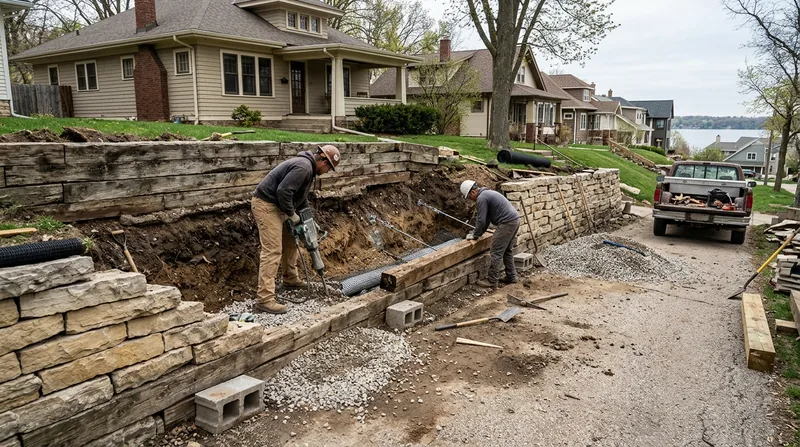




Leaning & Collapsed Wall Repair in Madison: When Your Wall Starts to Move
Madison sits between Lake Mendota and Lake Monona on glacial drumlins and moraine ridges, and that terrain puts a retaining wall on almost every block. The silty loess over glacial till, a high water table near the lakes and marshes, and deep freeze-thaw winters with frost heave are what push walls out of line. When a wall starts to lean, bulge, or collapse, Leaning & Collapsed Wall Repair in Madison is the call that keeps a small failure from becoming a driveway or foundation problem. We respond fast, stabilize what can be saved, and rebuild what cannot. If you are still weighing options, start with our retaining wall repair service page to see how we triage a failing wall.
Why Leaning Walls Are So Common on Madison's Lakeside Slopes
Most of the walls we repair in Tenney-Lapham, Marquette, and along the Spring Harbor bluffs were built decades ago with little or no drainage. Water builds up behind the wall, freezes, expands, and shoves the face outward a little more each winter. On the Isthmus and near the marshes, the water table stays high, so the soil behind the wall never really drains. The result is a slow lean that suddenly becomes a collapse after a wet spring or a hard thaw.
- Frost heave pushes saturated backfill against the wall every winter and does not relax in spring.
- Clogged weep holes and missing drain tile trap water behind block and timber walls.
- Tree roots from mature oaks and maples lift and crack wall caps and shift top courses.
- Original footings on 1950s-60s ranch lots in Hill Farms and Midvale Heights were often undersized for today's loads.
Each of these failure modes calls for a different fix, which is why we diagnose before we quote.
Key info: A wall in Nakoma that leans more than 2 inches out of plumb usually has a drainage problem, not just a soil problem. Fixing the lean without fixing the water behind it means the wall will move again within a few seasons.
For permit thresholds and setback rules, always confirm with the City of Madison Building Inspection Division before any rebuild; local requirements vary and must be verified for your specific lot. You can review the city's permit guidance at cityofmadison.com.
How We Stabilize and Rebuild a Failing Wall in Madison
We start by exposing the wall face and probing the backfill to find where the pressure is coming from. Then we relieve it before we straighten anything. A wall that is pushed out by water will keep pushing until the water has somewhere to go. We correct drainage first, then stabilize or rebuild, then restore the grade and planting.
- We inspect the wall, footing, and drainage, and mark the extent of the movement.
- We relieve water pressure by clearing weep holes and installing or repairing drain tile and gravel backfill.
- We stabilize the wall with tieback anchors or helical piers when the wall can be saved.
- We remove and rebuild failed sections when the wall cannot be saved, reusing sound stone where possible.
- We restore the grade, cap, and surface drainage so the repaired wall sheds water away from the slope.
Every repair ends with a drainage check, because that is what keeps the wall in place through the next Wisconsin winter.
Key info: On a walkout lot in Verona, a segmental block wall had bulged 4 inches after two wet springs. We anchored the wall, replaced the clogged drain tile, and rebuilt the top three courses. The homeowner avoided a full replacement and kept the original landscaping.
If your wall is beyond stabilization, see our retaining wall replacement page for full rebuild options.
Repair Methods We Use for Leaning and Collapsed Walls
The right method depends on wall type, height, and how far it has moved. We match the approach to the wall, not the other way around. Here is how the main options compare.
| Approach | Description | Best for |
|---|---|---|
| Tieback anchors | Steel anchors driven into stable soil behind the wall and tensioned to pull the face back to plumb. | Leaning block or concrete walls that are otherwise sound. |
| Drainage correction | New drain tile, gravel backfill, and weep holes to relieve water and frost pressure. | Bulging walls with saturated backfill and clogged drains. |
| Partial rebuild | Removing and resetting the failed section, reusing sound stone or block. | Localized collapse in limestone or fieldstone walls. |
| Helical piers | Screw piles installed under the footing to stop settlement and lift the wall back. | Walls sinking or rotating on soft lakeside soils. |
| Full rebuild | Removing the wall and rebuilding with modern drainage and a proper footing. | Timber walls rotted through or walls past stabilization. |
We will tell you honestly which method your wall needs after an on-site look.
Leaning & Collapsed Wall Repair Cost in Madison: What to Expect
Most leaning-wall repairs in Madison start around $2,500 and go up from there depending on wall length, height, and access. A short drainage correction on a 20-foot block wall is at the low end. A collapsed limestone wall on a steep lakeside lot in Maple Bluff or a walkout in Middleton can run well into five figures. We quote after we see the wall, not over the phone.
Cost drivers we look at: wall length and height, how far it has moved, whether the footing is sound, access for equipment, tree roots in the way, and whether permits or engineered drawings are required. For a fuller breakdown, see our pricing overview. Getting two or three estimates is smart, and we encourage it.
What to Look for When Hiring a Retaining Wall Contractor Near Me in Madison
Not every landscaper who builds walls can diagnose a failing one. Ask for proof of licensing and insurance, and confirm the coverage is current. Ask how they handle drainage, because that is where most repairs go wrong. Ask for references from jobs in your neighborhood, and check whether the wall type matches yours.
- Confirm the contractor is fully insured, and ask for a certificate before work starts.
- Get at least two written estimates that separate stabilization from drainage work.
- Ask whether permits are required for your wall height and whether the contractor pulls them.
- Check references for walls of similar material and age, not just new builds.
A contractor who cannot explain why your wall moved is guessing, and a guess is expensive on a retaining wall. Reach out through our contact page to schedule a look.
Leaning & Collapsed Wall Repair in Madison: Pricing Guide
| Service | Price | Details |
|---|---|---|
| Drainage correction and re-setting | Starting at $2,500 | Includes clearing weep holes, new drain tile, and gravel backfill on a short wall. |
| Tieback anchor stabilization | Starting at $3,800 | Anchors a leaning block or concrete wall back to plumb; price rises with wall length. |
| Partial rebuild | Starting at $4,500 | Removes and resets the failed section; access and stone reuse affect the final number. |
| Full rebuild of a collapsed wall | On estimate | Needs an on-site look to price footing, drainage, and haul-off of failed material. |
| Travel | Included | In Madison and surrounding areas, no separate call-out or mileage fee. |
| Estimate | Free | Response within 24h at (608) 910-8974, no obligation to book. |
Indicative pricing, the exact cost depends on square footage, finish, and site access. Free personalized estimate within 24h at (608) 910-8974.


