



Slope Stabilization & Erosion Control in Madison
Madison sits on glacial drumlins and moraine ridges between Lake Mendota and Lake Monona, so a lot of homes here are built into a slope rather than on flat ground. That means slope stabilization and erosion control in Madison is not a cosmetic upgrade. It is what keeps a walkout lot in Spring Harbor from sliding, a hilly front yard in University Heights from washing out, and a lakeside bank in Tenney-Lapham from creeping toward the house. The soils here are silty loess over glacial till, the water table runs high near the lakes and marshes, and deep freeze-thaw winters push frost heave into every wall footing. When a slope starts to move, the fix has to address water, soil, and load together. We build terraced walls, set geogrid reinforcement, and install drainage that moves water away from the hill instead of through it. If you are already seeing a wall lean or bulge, start with leaning and collapsed wall repair before the slope takes the rest of the yard with it.
Why Slope Stabilization Matters on Madison's Drumlin Hillsides and Lakeshore Lots
The failure mode that dominates in Madison is frost heave combined with saturated silty loess. Every winter, water enters the slope, freezes, expands, and lifts. Every spring, it thaws and the soil loses strength right when it is heaviest. On the moraine ridges in Nakoma and Westmorland, that shows up as slumping turf and cracked driveways. On the lakeshore lots near Monona and Waunakee, it shows up as undercut banks and sediment running into the water.
- Frost heave pushes wall footings out of line and opens joints in buff limestone and segmental block walls.
- High water tables near the lakes saturate the till and reduce bearing capacity under driveways and patios.
- Silty loess erodes fast on bare slopes, especially on the steep front yards common in Hill Farms and Midvale Heights.
- Aging timber and railroad tie walls rot at the soil line and release the slope they were holding.
- Roof and driveway runoff concentrated at one point cuts gullies that undermine existing walls.
Left alone, each of these gets worse every freeze-thaw cycle, and the repair scope grows with it.
Key info: A lakeside lot in Monona with a failing timber wall and a saturated bank is a different job from a dry drumlin slope in Fitchburg. We scope the water first, then the wall, because a wall that does not drain will fail again within a few winters.
For official guidance on grading, drainage, and erosion control requirements, check the City of Madison building inspection and stormwater resources at cityofmadison.com before you start digging.
How We Stabilize a Madison Slope: Assess, Drain, Terrace, Reinforce
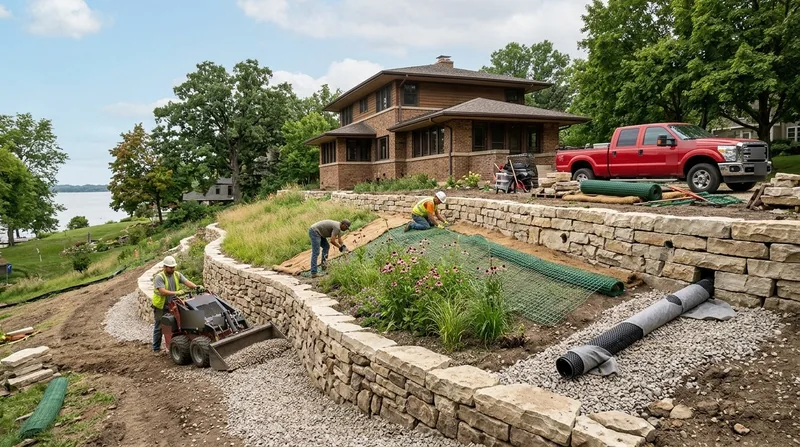
We start by reading the slope, not by quoting a wall. We look at where the water comes from, how steep the grade runs, what the soil is doing under the surface, and what sits above and below the slope. On a walkout lot in Verona or a hilly yard in Middleton, that often means terracing the slope into two shorter walls instead of one tall wall that takes the full load.
- We walk the slope and map the drainage, including roof downspouts, driveway runoff, and any springs or seepage lines.
- We check the existing wall, footing, and soil for movement, rot, or saturation before deciding repair versus replacement.
- We design the terrace layout and set geogrid reinforcement in lifts behind the wall to tie the retained soil back into the slope.
- We install drainage behind the wall (gravel, filter fabric, perforated pipe) and outlet it away from the slope.
- We build the wall in segmental block, boulder, or poured concrete and compact each lift as we go.
- We finish the surface with erosion control, seeding, or plantings that hold the exposed soil through the next thaw.
Every step is done with the freeze-thaw cycle in mind, because a footing set too shallow in Madison soil will lift within a few seasons.
Local example: On a wooded lot in Nakoma, a 1950s ranch had a leaning timber wall holding a steep bank above the driveway. We replaced it with a terraced segmental block wall, set geogrid in three lifts, and tied the downspouts into a new drainage line that outlets at the street. The driveway stopped cracking the following spring.
If the slope problem is really a water problem, our retaining wall drainage work is where we start.
Slope Stabilization Approaches We Use on Madison Properties
Not every slope needs the same fix. The right approach depends on grade, soil, water, and what the slope is holding up. Here is how the main options compare on Madison terrain.
| Approach | Description | Best for |
|---|---|---|
| Terraced segmental block walls | Two or more shorter walls stepping up the slope, with geogrid tying each lift back into the soil. | Steep walkout lots and hilly front yards in Verona, Middleton, and Fitchburg. |
| Boulder and natural stone toe walls | Heavy rock set at the base of the slope to hold the toe and slow runoff. | Lakeshore banks and wooded slopes where a natural look fits the setting. |
| Poured concrete retaining walls | Reinforced concrete wall designed to carry heavier surcharge loads. | Slopes supporting a driveway, garage, or structure above. |
| Drainage and erosion control | Perforated pipe, gravel, filter fabric, grading, and seeding to move water off the slope. | Saturated banks, gullied yards, and any slope where water is the driver. |
| Timber and railroad tie replacement | Removing rotted timber and rebuilding the slope support with a durable wall system. | Aging timber walls in older Madison neighborhoods that have started to lean. |
We pick the approach that matches the slope and the budget, not the one that is easiest to sell.
Slope Stabilization & Erosion Control Cost in Madison: What to Expect
Every slope stabilization job starts with a free on-site estimate, because the price depends on the slope itself. A short terraced wall on a dry drumlin in Fitchburg is a very different number from a lakeside bank repair in Monona with saturated till and limited access. We give you a scope and a number after we have seen the water and the soil, not before.
The main cost drivers are slope height and grade, soil and water conditions, access for equipment, wall material (segmental block, boulder, or poured concrete), how much geogrid reinforcement the design needs, and whether the existing wall has to come out first. Proximity to the house, driveway, or a property line can add labor. Emergency work on a slope that is actively moving costs more than planned work.
Get two or three estimates and compare scope, not just price. A low bid that skips drainage or geogrid will cost more in five years when the wall leans. See our pricing overview for the full breakdown of what each scope includes.
Hiring a Retaining Wall Contractor Near Me in Madison: What to Check
Slope work is structural work, so verify the basics before anyone touches the hill. Ask for proof of licensing and insurance, and confirm the policy covers excavation and wall work, not just general landscaping. Get at least two or three written estimates with the scope spelled out, including drainage and reinforcement, so you can compare like for like.
Ask for local references on slopes similar to yours, and call them. Check whether a permit is required for your wall height and surcharge, since thresholds vary by jurisdiction and the local building department makes the call. If you are in an HOA or a historic district in Nakoma or University Heights, confirm the approval requirements before the design is finalized.
When you are ready to talk through your slope, reach out through our contact page and we will set up a free estimate.
Slope Stabilization & Erosion Control Near Me: What Madison Homeowners Should Know
If you are searching for slope stabilization near me in Madison, the first thing to understand is that the slope is usually telling you something about water. Soggy ground at the base of a wall, a crack that opens wider each spring, or turf that slides after a thaw are all signs the drainage is failing. Catching it early is the difference between a targeted repair and a full rebuild.
We work across Madison and the surrounding communities, including Middleton, Fitchburg, Sun Prairie, Verona, Monona, Waunakee, and McFarland. If your slope is already moving, call (608) 910-8974 and we will get out to look at it. Fully insured.
Slope Stabilization & Erosion Control in Madison: Pricing Guide
| Service | Price | Details |
|---|---|---|
| Slope assessment and free estimate | Free estimate | On-site walk of the slope, drainage check, and written scope before any work is priced. |
| Drainage and erosion control only | Starting at $1,800 | Perforated pipe, gravel, filter fabric, grading, and seeding on a manageable slope. |
| Terraced segmental block stabilization | Starting at $6,500 | One to two terraces with geogrid, drainage, and block wall on a typical residential slope. |
| Boulder or poured concrete slope wall | On estimate | Heavier materials and surcharge loads need an on-site look before a number is given. |
| Emergency slope or wall repair | On estimate | Active movement, undermined footings, or collapsed sections are scoped after inspection. |
| Travel | Included | In Madison and surrounding areas, no separate call-out or mileage fee. |
Indicative pricing, the exact cost depends on square footage, finish, and site access. Free personalized estimate within 24h at (608) 910-8974.


