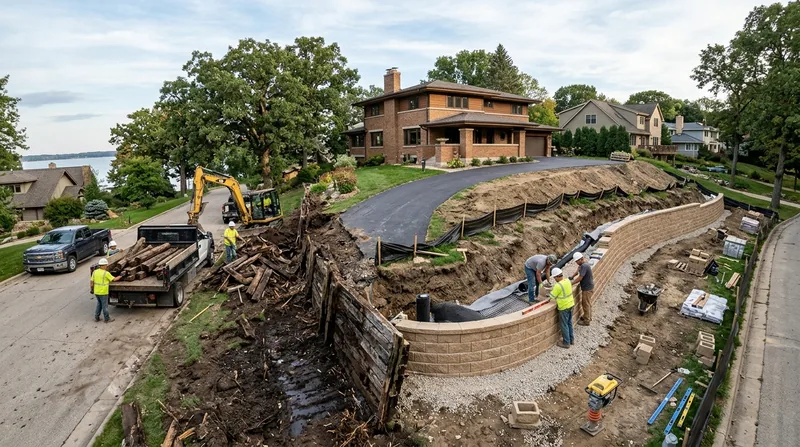




Retaining Wall Replacement in Madison: When the Old Wall Has to Come Out
Madison sits on glacial drumlins and moraine ridges between Lake Mendota and Lake Monona, so lakeside slopes, hilly front yards and walkout lots are everywhere. That terrain is hard on walls. The silty loess over glacial till, the high water table near the lakes and marshes, and deep freeze-thaw winters with frost heave push old walls out of line year after year. If your wall is leaning, bulging or crumbling, Retaining Wall Replacement in Madison is the honest answer when repair no longer buys you time. We tear out the failed wall, haul it away, fix the drainage and set a modern engineered wall below frost depth. For a wall that is still standing but out of plumb, start with retaining wall repair before you commit to a full tear-out.
Why So Many Madison Walls Are Ready for Replacement
Most of the walls we replace in Madison were built 25 to 50 years ago, and many of them are timber or railroad tie walls that have simply rotted through. The Isthmus neighborhoods (Tenney-Lapham, Marquette, Vilas, University Heights) and the wooded streets of Nakoma and Westmorland have plenty of buff limestone and fieldstone walls that have lost their drainage. Out in Hill Farms, Midvale Heights and Spring Harbor, 1950s and 60s ranches often have poured concrete walls cracked by frost heave. Newer subdivisions in Middleton, Fitchburg, Verona and Sun Prairie are seeing segmental block walls fail early because the drainage behind them was never done right.
- Timber and railroad tie walls rot at the soil line and start leaning within 15 to 20 years.
- Frost heave lifts and cracks shallow footings that were never set below the frost line.
- Clogged or missing drain tile lets water build up behind the wall and push it out.
- Tree roots and settling soil open gaps that let water in and weaken the base.
When two or more of those are working against you, replacement is usually cheaper than patching the same wall every couple of years.
Key info: A railroad tie wall on a slope in Monona that has rotted through at the base is a replacement job, not a repair job. The same goes for a poured concrete wall in Vilas that has cracked and heaved after 40 winters.
Permits and wall rules vary by jurisdiction, so confirm the current requirements with the City of Madison building department before any tear-out begins: City of Madison Department of Planning and Community and Economic Development.
How We Replace a Failed Wall in Madison, Step by Step
Replacement is a sequence, and skipping a step is how walls fail early. We start by finding out why the old wall gave out, because if the drainage or the soil is the problem, a new wall built the same way will fail the same way. Then we tear out, haul away, rebuild the base below frost depth and put in drainage that actually moves water away from the wall.
- We inspect the wall, the slope and the drainage, and we check the property line and any permit thresholds.
- We remove the old wall, footing and backfill, and haul the debris away.
- We excavate to the new footing depth, below the local frost line, and compact the base.
- We install drain tile, washed stone and filter fabric so water never sits behind the new wall.
- We build the new wall in the material you choose, with proper batter and compaction.
- We backfill in lifts, compact, and restore the grade and any plantings.
Every step gets checked before we move to the next one, and you get a walkthrough at the end.
Key info: On a walkout lot in Fitchburg, we replaced a leaning timber wall with a segmental block wall set below frost depth and tied into new drain tile. The old wall had no drainage at all, which is why it went over. See how we handle the water side on our retaining wall drainage page.
Replacement Approaches We Use in Madison
The right replacement material depends on the height of the wall, the load behind it, the slope and your budget. These are the approaches we build most often around Madison.
| Approach | Description | Best for |
|---|---|---|
| Segmental block replacement | Engineered block wall with geogrid and drain tile, set below frost depth. | Most residential walls up to 4 to 6 feet, tiered walls. |
| Poured concrete replacement | Reinforced concrete wall with a proper footing and waterproofing. | Tall walls, walls carrying a driveway or structure surcharge. |
| Boulder and natural stone | Fieldstone or boulder wall rebuilt with modern drainage behind it. | Lakeside slopes and landscaped yards where the look matters. |
| Timber and tie wall replacement | Rotted timber or railroad tie wall torn out and rebuilt in a durable material. | Aging tie walls on hillside yards and garden terraces. |
| Engineered tiered replacement | Two or more stepped walls with geogrid and drainage, sized by an engineer. | Tall slopes and walls above the local permit threshold. |
We match the material to the site, not the other way around, so the new wall holds up to Madison winters.
Retaining Wall Replacement Cost in Madison: What to Expect
Replacement pricing starts from $35 per square foot of wall face, and that figure is a starting point, not a fixed quote. The number moves with wall height, the material you choose, how tight the access is, and how much of the old wall has to be torn out and hauled away. A short garden wall in Cottage Grove and a tall lakeside wall in Monona are not the same job, even if they look similar from the street.
- Wall height and length drive the square footage and the amount of material.
- Access matters: a backyard wall you can only reach through a gate costs more in labor.
- Material choice moves the price, from timber to block to poured concrete.
- Old wall removal and haul-away add cost when the wall is deep or tied into the slope.
- Proximity to the house, a driveway or a structure can require shoring and careful work.
- Engineered drawings and permits add cost on tall or tiered walls.
Get two or three written estimates on the same scope so you can compare them fairly. Our full pricing overview breaks down what goes into each number.
Hiring a Retaining Wall Contractor Near Me in Madison: What to Check
Replacement is a bigger job than repair, so check the contractor before you sign anything. Ask for proof of license and insurance, and make sure the certificate covers the work being done. Get at least two or three estimates and compare the scope, not just the total. Ask for references from jobs like yours, and call them. Confirm who pulls the permit and whether engineered drawings are needed for your wall height. If you live in an HOA, check the rules on wall material, height and color before work starts.
A contractor who answers those questions clearly and puts the scope in writing is the one you want. Reach us through our contact page to set up a free estimate.
Retaining Wall Replacement in Madison: Pricing Guide
| Service | Price | Details |
|---|---|---|
| Timber or railroad tie wall replacement | Starting at $35/sq ft | Includes tear-out, haul-away, new drainage and a durable replacement wall built below frost depth. |
| Segmental block wall replacement | Starting at $45/sq ft | Includes engineered block, geogrid, drain tile and compaction, with height and access moving the price. |
| Poured concrete wall replacement | Starting at $55/sq ft | Includes reinforced footing, formwork, waterproofing and drainage, with surcharge loads raising the number. |
| Boulder and natural stone replacement | Starting at $50/sq ft | Includes stone reset or new boulder wall with drainage, with stone size and haul distance affecting cost. |
| Complex or large-scale job | On estimate | Tall, tiered or lakeside walls need an on-site look, soil review and possibly engineered drawings before pricing. |
| Estimate | Free | Response within 24 hours at (608) 910-8974, no obligation to book the work. |
Indicative pricing, the exact cost depends on square footage, finish, and site access. Free personalized estimate within 24h at (608) 910-8974.


